My M.Tech thesis was on standing waves in rotating tires. It sounds narrow. It turned out to be a masterclass in how rotation breaks everything you thought you knew about structural mechanics.
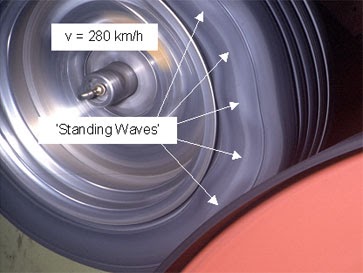
The Problem Nobody Warns You About
A tire at rest is just a pressurized toroidal shell. You can do Hertzian contact analysis on it, compute deflection, estimate contact patch pressure - all standard stuff.
Put it in motion and everything changes.
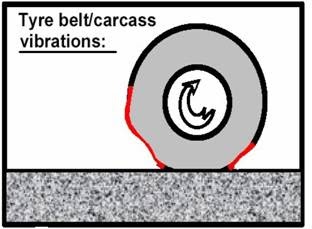
At low speeds, not much happens. The contact patch deforms, recovers, repeat. Fine. But as rotational speed increases, the deformation wave generated at the contact patch doesn’t have time to fully dissipate before the next contact event. The wave speed in the structure depends on the ring’s rotational speed and its physical properties. At certain speeds, the forcing frequency from the road matches a natural frequency of the rotating ring. Standing waves form.
These aren’t standing waves in the audio-room sense - they’re spatial oscillation patterns locked into the tire sidewall. The amplitude can build significantly. Uneven wear, noise, handling degradation. In extreme cases, structural failure.
The interesting part is that the critical speed depends on the wave propagation speed in the pressurized rotating ring - which itself is a function of inflation pressure, rotational speed, and material stiffness. These are all coupled. You can’t linearize your way out of it.
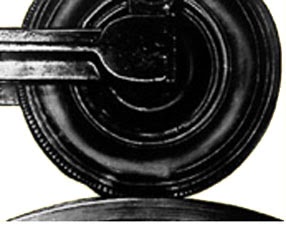
Contact Mechanics: Where Local Meets Global
The contact patch is where the entire vehicle load concentrates into a patch roughly the size of your palm. What happens there determines grip, rolling resistance, wear pattern, and NVH signature.
Hertzian contact gives you a starting point - pressure distribution, contact half-width. But it assumes smooth surfaces, linearly elastic materials, and small deformations. Real tires violate all three.
The refinements that matter:
- Inflation pressure changes the effective structural stiffness, shifting both contact geometry and wave speeds
- Hysteretic material behavior means the loading and unloading pressure profiles differ - that asymmetry is where rolling resistance lives
- Temperature-dependent rubber properties mean the contact behavior at 80°C (post-motorway) is different from cold start - a fact that compound designers and vehicle dynamicists sometimes argue about
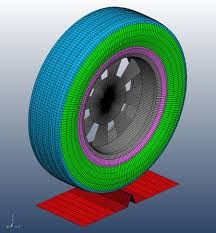
The Tire Model in Detail
The rotating ring model requires coupling in-plane and out-of-plane modes through Coriolis and centrifugal terms. This isn’t optional - miss either and your critical velocity prediction is wrong.
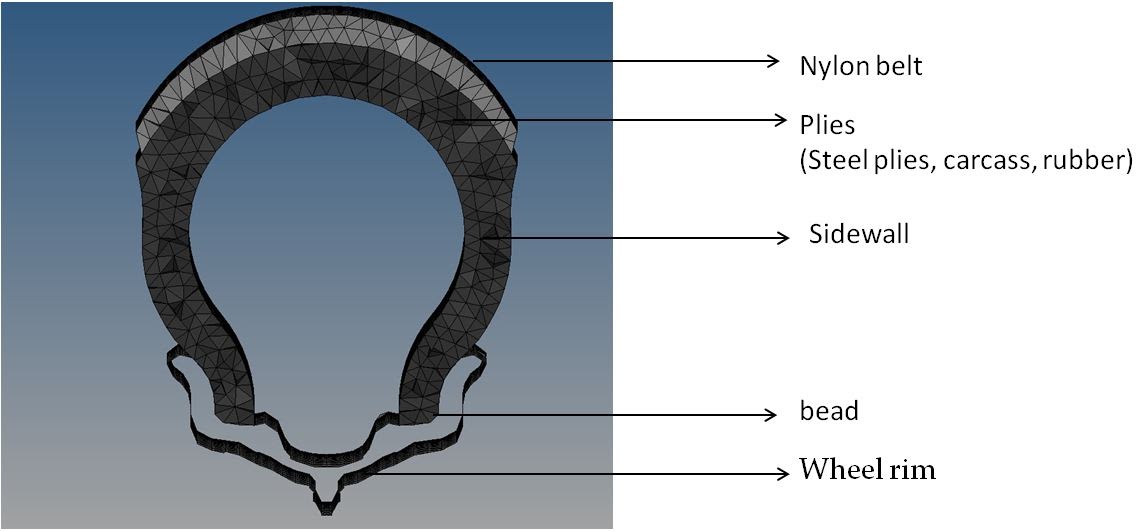
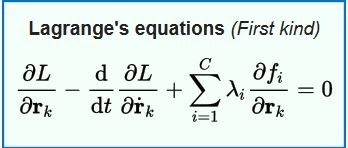
The governing equations are derived from Lagrangian mechanics applied to a rotating elastic ring with foundation stiffness. The rotating frame introduces fictitious forces (Coriolis, centrifugal) that couple modes which would be independent in a static structure.
Why Rotating Systems Are a Different Beast
Static analysis tells you where stresses are high. Dynamic analysis tells you how the structure responds to forcing. But rotating structures add a third dimension: the rotation itself becomes part of the structural stiffness.
In a rotating ring, you get:
- Coriolis effects - forces perpendicular to motion, coupling in-plane and out-of-plane modes
- Centrifugal stiffening - the rotation adds apparent stiffness (like a skipping rope)
- Gyroscopic terms - which shift natural frequencies depending on spin speed
Miss any of these in your model, and your natural frequency predictions are wrong. Which means your resonance predictions are wrong. Which means you’re designing around the wrong failure mode.
This pattern recurs. I saw the same logic later in shaft dynamics, in satellite fuel slosh, in nutational damping - any system where rotation is not just kinematics but structural physics.
Patterns I Keep Seeing
Failure often lives at the intersection of two phenomena. Standing waves don’t arise from high speed alone or from structural resonance alone - they arise when both conditions align. Engineering problems that look like single-cause failures are usually coincident-cause failures.
The boundary conditions matter more than the governing equations. The ring equation is well-known. What changes the behavior is how it’s pressurized, how it contacts the road, how the material responds at that load and temperature. Same equation, different answer depending on what’s at the edge.
Where This Work Connects
The thinking from this thesis shows up repeatedly - contact mechanics in piston rings, mode coupling in engine mounts, wave propagation in battery electrode structures (yes, the same math). The specific system changes. The underlying physics doesn’t.