AI coding systems frequently lack persistent structural understanding of repositories. They can generate code. They struggle to reason about a codebase they didn’t write.
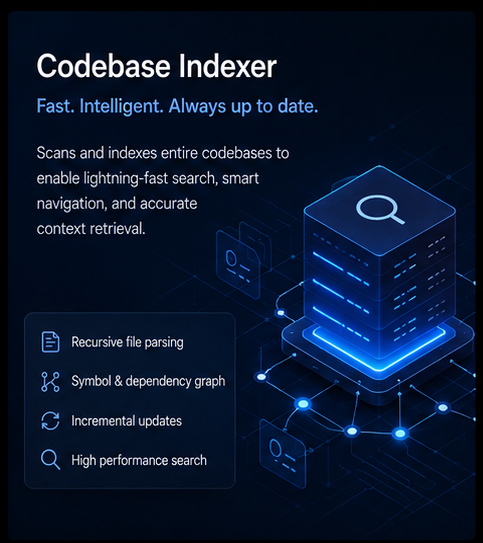
This project built a system that gives a local LLM a structural map of any Python repository - before it touches a single line of code.
The Problem
Large codebases are opaque. You can read files sequentially, but you can’t reason about dependency structure, identify which modules are most central, or understand what a change to one function propagates to - not without analysis tooling.
An agent without this context makes locally-correct edits that break things three layers up. It’s not a generation problem. It’s a comprehension problem.
Architecture
graph LR
    A[Repository Files] --> B[Parser Layer]
    B --> C[Symbol Extraction]
    B --> D[Dependency Graph]
    B --> E[Semantic Chunks]
    C --> F[Knowledge Layer]
    D --> F
    E --> F
    F --> G[Query Interface]
What the system builds:
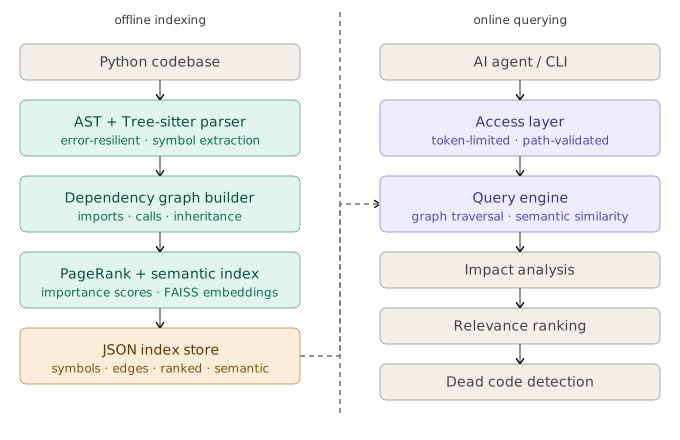
- Symbol maps - every function, class, and module extracted and cross-referenced
- Dependency graphs - what imports what, what calls what, which modules are most connected
- Importance scoring - centrality-based ranking of which components matter most
- Semantic retrieval layer - FAISS-based vector search over code chunks for natural language queries
- Repository memory - persistent index that survives between agent sessions
Why This Matters for Agents
An agent with access to a structural index can form a plan before touching code. It can:
- Identify the right entry point for a task
- Understand the blast radius of a proposed change
- Avoid edits that look locally correct but break something upstream
This is the difference between an agent that generates and an agent that understands. The index doesn’t replace the LLM - it gives it better information to reason from.
Runs on local LLMs (LM Studio) - no data leaves the machine. Relevant for GDPR-constrained engineering environments where sending codebase context to external APIs is not an option.
What Made This Hard
The importance scoring problem. Centrality in a dependency graph is not the same as importance to a developer. A utility module imported by 40 files is central but not necessarily the most important thing to understand before making a change. Getting the scoring to reflect semantic importance - not just graph topology - required combining betweenness centrality with call-frequency weighting and explicit handling of interface modules.
Keeping the index current without full re-indexing. A codebase changes continuously. Re-running full static analysis on every file change is expensive. The indexer uses incremental updates - detecting which files changed, re-parsing only those, and propagating dependency updates through the graph rather than rebuilding from scratch.
Context budget management. A local LLM has a limited context window. The indexer’s query layer has to return the right information density: enough structural context to reason about the task, not so much that it crowds out the actual code the agent needs to read. This is a retrieval design problem, not a parsing problem.
In Use
The Codebase Indexer is the pre-flight check before any AI agent touches a repository. It feeds the Hybrid Code Analyzer for correlation between structural importance and runtime failures. Both run on local LLMs via LM Studio - no data leaves the machine, which is a hard requirement in GDPR-constrained environments.
Connects To
Thinking: AI as Reasoning Infrastructure Project: Hybrid Code Analyzer Project: AI-Assisted Simulation Debugger